Ford
Kuga
Ford Kuga: anni di prima immatricolazione in Europa, aiuto sui codici di errore, spie e guide alla manutenzione.
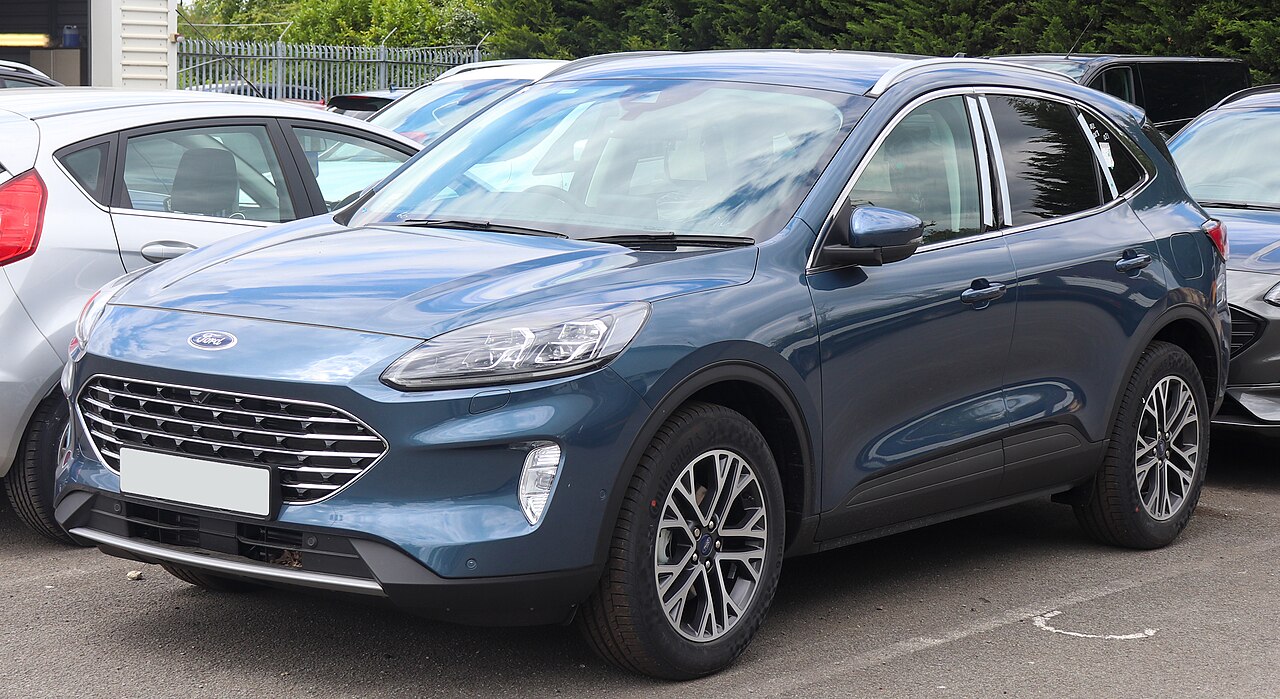 Foto con licenza · Crediti
MarcaFord
Nuove immatricolazioni (UE)2008–2026
Generazioni e specifiche tecniche
Ford Kuga – 3ª generazione2019–oggi
| Caratteristica | Valore |
|---|---|
| Produzione | 2019–2025 (Nord America) 2019–oggi (Europa) 2020–2026 (Taiwan) |
| Piattaforma | Ford C2 |
| Motori | Benzina 1,5 L EcoBoost I3 turbo 2,0 L EcoBoost I4 turbo Benzina ibrido 2,5 L Duratec iVCT I4 Benzina ibrido plug-in 2,5 L Duratec I4 Diesel 1,5 L EcoBlue I4 turbo 2,0 L EcoBlue I4 turbo 2,0 L EcoBlue I4 turbo mild hybrid |
| Motore elettrico | 11,5 kW belt-driven integrated starter/generator (BISG) (mild hybrid) 88 kW Permanent-magnet synchronous AC electric motor (ibrido and ibrido plug-in) |
| Cambi | 6 marce manuale 6 marce Powershift DCT 8 marce 8F40 automatico CVT |
| Trasmissione | Mild hybrid Parallel ibrido Ibrido plug-in |
| Batteria | 48 V (mild hybrid) 1,1 kWh lithium-ion (ibrido) 14,4 kWh lithium-ion (ibrido plug-in) |
| Passo | 2.690 mm |
| Assemblaggio | Spagna: Valencia (Ford Valencia Plant) Germania: Cologne (Cologne Body & Assembly, Vignale trim) Stati Uniti: Louisville, Kentucky (Louisville Assembly Plant, Escape) Cina: Chongqing (Changan Ford) Taiwan: Zhongli, Taoyuan (Ford Lio Ho) |
| Designer | Andrew Bazinski Christopher Giroux, Nedzad Mujcinovic, Jordan Demkiw (restyling) |
Ford Kuga – 2ª generazione2012–2021
| Caratteristica | Valore |
|---|---|
| Produzione | 2012–2019 (Europa) 2013–2021 (Cina) |
| Piattaforma | Ford C1 platform |
| Motori | Benzina 1,5 L EcoBoost I4 turbo 1,6 L EcoBoost I4 turbo 2,0 L EcoBoost I4 turbo 2,5 L Duratec I4 Diesel 1,5 L Duratorq TDCi I4 turbo 2,0 L Duratorq I4 turbo |
| Cambi | 6 marce manuale 6 marce 6F35 automatico 6 marce PowerShift automatico |
| Passo | 2.690 mm |
| Lunghezza | 4.524 mm |
| Larghezza | 1.838 mm |
| Altezza | 1.702 mm |
| Peso a vuoto | 1.580–1.707 kg |
| Assemblaggio | Spagna: Valencia (FV) Cina: Chongqing (Changan Ford) Russia: Yelabuga (FS) Stati Uniti: Louisville, Kentucky (Louisville Assembly Plant, Escape) |
| Designer | Patrick Verhee, Stefan Lamm, Andrea Di Buduo, Kemal Curić (2010) |
Ford Kuga – 1ª generazione2008–2013
| Caratteristica | Valore |
|---|---|
| Produzione | febbraio 2008 – 2013 |
| Piattaforma | Ford C1 platform |
| Motori | Benzina 2,5 L Duratec I5 turbo Diesel 2,0 L Duratorq TDCi I4 turbo |
| Cambi | 6 marce Durashift manuale 5 marce Durashift automatico 6 marce PowerShift doppia frizione automatico |
| Passo | 2.690 mm |
| Lunghezza | 4.443 mm |
| Larghezza | 1.842 mm |
| Altezza | 1.710 mm |
| Peso a vuoto | 1.613 kg |
| Assemblaggio | Germania: Saarlouis (SB&A) |
Dati di omologazione UE
| Anni | Alimentazione | Motore | Potenza | Massa | CO₂ | Autonomia elettrica |
|---|---|---|---|---|---|---|
| 2020–2025 | Benzina | 1496 cm³ | 111 kW (151 CV) | 1564 kg | 147–155 g/km (WLTP) | – |
| 2024–2025 | Ibrida benzina | 2488 cm³ | 111 kW (151 CV) | 1689–1765 kg | 122–133 g/km (WLTP) | – |
| 2024–2025 | Ibrida plug-in benzina | 2488 cm³ | 111 kW (151 CV) | 1859–1901 kg | 20–23 g/km (WLTP) | 66–69 km · 162–165 Wh/km |
| 2024–2025 | E85 flex fuel | 2488 cm³ | 111 kW (151 CV) | 1689 kg | 122–128 g/km (WLTP) | – |
| 2020–2024 | Benzina | 1496 cm³ | 110 kW (150 CV) | 1564–1601 kg | 149–155 g/km (WLTP) | – |
| 2020–2024 | Ibrida benzina | 2488 cm³ | 112 kW (152 CV) | 1701–1773 kg | 124–134 g/km (WLTP) | – |
| 2020–2024 | Ibrida plug-in benzina | 2488 cm³ | 112 kW (152 CV) | 1844 kg | 22–32 g/km (WLTP) | 56–72 km · 72–168 Wh/km |
| 2023–2024 | Diesel | 1995 cm³ | 88 kW (120 CV) | 1667–1735 kg | 149–156 g/km (WLTP) | – |
| 2021–2024 | E85 flex fuel | 2488 cm³ | 112 kW (152 CV) | 1701 kg | 119–127 g/km (WLTP) | – |
| 2020–2023 | Diesel | 1995 cm³ | 140 kW (190 CV) | 1735 kg | 150–161 g/km (WLTP) | – |
| 2016–2022 | Diesel | 1499 cm³ | 88 kW (120 CV) | 1576–1654 kg | 124–164 g/km (WLTP) | – |
| 2020–2022 | Ibrida diesel | 1995 cm³ | 110 kW (150 CV) | 1680 kg | 128–136 g/km (WLTP) | – |
| 2015–2020 | Benzina | 1498 cm³ | 110 kW (150 CV) | 1579–1638 kg | 176–208 g/km (WLTP) | – |
| 2018–2020 | Benzina | 1498 cm³ | 129 kW (175 CV) | 1739 kg | 215–223 g/km (WLTP) | – |
| 2014–2020 | Diesel | 1997 cm³ | 88 kW (120 CV) | 1614–1751 kg | 168–198 g/km (WLTP) | – |
| 2014–2020 | Diesel | 1997 cm³ | 132 kW (179 CV) | 1702–1815 kg | 188–198 g/km (WLTP) | – |
| 2016–2019 | Benzina | 1498 cm³ | 88 kW (120 CV) | 1579–1630 kg | 172–191 g/km (WLTP) | – |
| 2014–2019 | Diesel | 1997 cm³ | 110 kW (150 CV) | 1614–1790 kg | 172–198 g/km (WLTP) | – |
| 2019 | E85 flex fuel | 1498 cm³ | 110 kW (150 CV) | 1615–1668 kg | 181–215 g/km (WLTP) | – |
| 2015–2018 | Benzina | 1498 cm³ | 134 kW (182 CV) | 1686 kg | 151–228 g/km (WLTP) | – |
| 2013–2015 | Benzina | 1596 cm³ | 110 kW (150 CV) | 1580 kg | 154 g/km (NEDC) | – |
| 2011–2015 | Diesel | 1997 cm³ | 103 kW (140 CV) | 1584–1707 kg | 139–162 g/km (NEDC) | – |
| 2011–2015 | Diesel | 1997 cm³ | 120 kW (163 CV) | 1614–1707 kg | 154–179 g/km (NEDC) | – |
Gli anni sono anni di immatricolazione. Ogni intervallo va dal 10° al 90° percentile dei valori dichiarati per le nuove immatricolazioni; non è una media. La massa è la massa in ordine di marcia. Per le auto elettriche la potenza è la potenza netta di omologazione, che può essere inferiore alla potenza massima dichiarata.
Caratteristiche principali
| Caratteristica | Valore |
|---|---|
| Motorizzazioni (UE) | Benzina, Ibrida benzina, Ibrida plug-in benzina, Diesel |
| Cilindrata (UE) | 1.496–2.488 cm³ |
| Potenza (UE) | 88–132 kW (120–179 CV) |
| Massa in ordine di marcia (UE) | 1.564–1.901 kg |
| Passo (UE) | 2.690–2.710 mm |
Anni e mercati
| Caratteristica | Valore |
|---|---|
| Nuove immatricolazioni (UE) | 2008–2026 |