Ford
Kuga
Ford Kuga : années d’immatriculation neuve en Europe, aide sur les codes défaut, voyants et guides d’entretien.
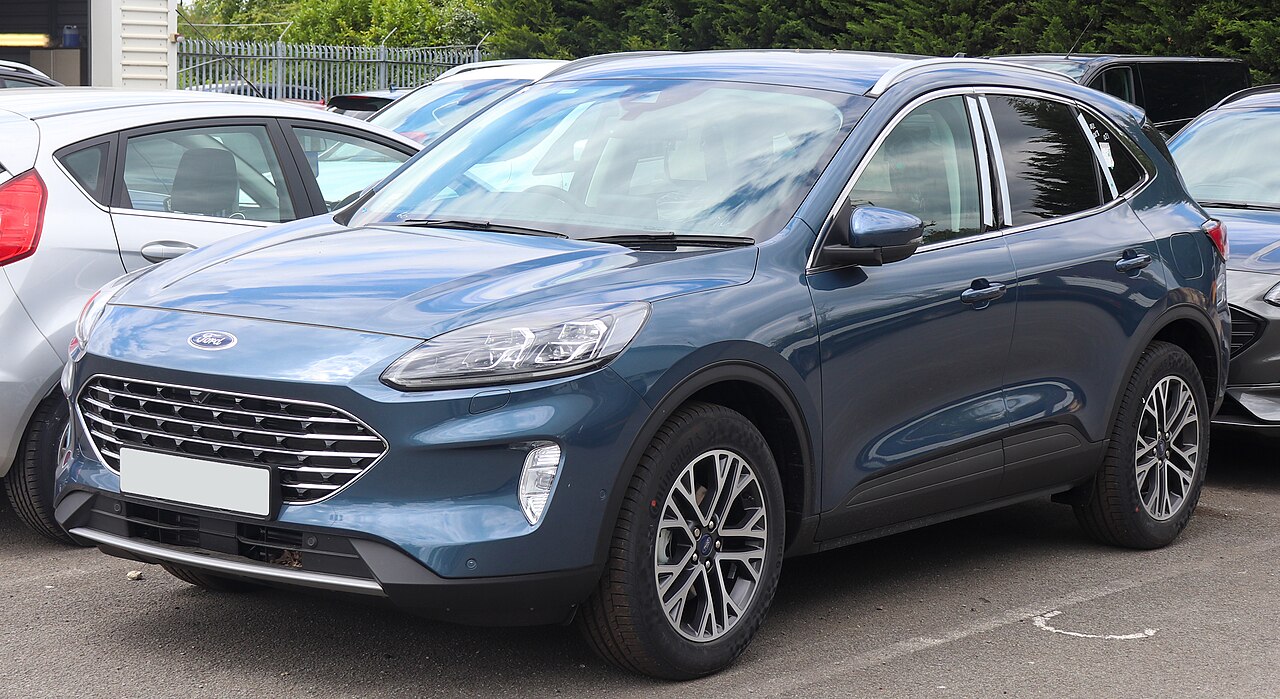 Photo sous licence · Crédit
MarqueFord
Immatriculations neuves (UE)2008–2026
Générations et caractéristiques techniques
Ford Kuga – 3e génération2019–aujourd’hui
| Caractéristique | Valeur |
|---|---|
| Production | 2019–2025 (Amérique du Nord) 2019–aujourd’hui (Europe) 2020–2026 (Taïwan) |
| Plateforme | Ford C2 |
| Moteurs | Essence 1,5 L EcoBoost I3 turbo 2,0 L EcoBoost I4 turbo Essence hybride 2,5 L Duratec iVCT I4 Essence hybride rechargeable 2,5 L Duratec I4 Diesel 1,5 L EcoBlue I4 turbo 2,0 L EcoBlue I4 turbo 2,0 L EcoBlue I4 turbo hybride léger |
| Moteur électrique | 11,5 kW belt-driven integrated starter/generator (BISG) (hybride léger) 88 kW Permanent-magnet synchronous AC electric motor (hybride and hybride rechargeable) |
| Boîtes de vitesses | 6 rapports manuelle 6 rapports Powershift DCT 8 rapports 8F40 automatique CVT |
| Chaîne de traction | Hybride léger Parallel hybride Hybride rechargeable |
| Batterie | 48 V (hybride léger) 1,1 kWh lithium-ion (hybride) 14,4 kWh lithium-ion (hybride rechargeable) |
| Empattement | 2 690 mm |
| Assemblage | Espagne: Valencia (Ford Valencia Plant) Allemagne: Cologne (Cologne Body & Assembly, Vignale trim) États-Unis: Louisville, Kentucky (Louisville Assembly Plant, Escape) Chine: Chongqing (Changan Ford) Taïwan: Zhongli, Taoyuan (Ford Lio Ho) |
| Designer | Andrew Bazinski Christopher Giroux, Nedzad Mujcinovic, Jordan Demkiw (restylage) |
Ford Kuga – 2e génération2012–2021
| Caractéristique | Valeur |
|---|---|
| Production | 2012–2019 (Europe) 2013–2021 (Chine) |
| Plateforme | Ford C1 platform |
| Moteurs | Essence 1,5 L EcoBoost I4 turbo 1,6 L EcoBoost I4 turbo 2,0 L EcoBoost I4 turbo 2,5 L Duratec I4 Diesel 1,5 L Duratorq TDCi I4 turbo 2,0 L Duratorq I4 turbo |
| Boîtes de vitesses | 6 rapports manuelle 6 rapports 6F35 automatique 6 rapports PowerShift automatique |
| Empattement | 2 690 mm |
| Longueur | 4 524 mm |
| Largeur | 1 838 mm |
| Hauteur | 1 702 mm |
| Poids à vide | 1 580–1 707 kg |
| Assemblage | Espagne: Valencia (FV) Chine: Chongqing (Changan Ford) Russie: Yelabuga (FS) États-Unis: Louisville, Kentucky (Louisville Assembly Plant, Escape) |
| Designer | Patrick Verhee, Stefan Lamm, Andrea Di Buduo, Kemal Curić (2010) |
Ford Kuga – 1re génération2008–2013
| Caractéristique | Valeur |
|---|---|
| Production | février 2008 – 2013 |
| Plateforme | Ford C1 platform |
| Moteurs | Essence 2,5 L Duratec I5 turbo Diesel 2,0 L Duratorq TDCi I4 turbo |
| Boîtes de vitesses | 6 rapports Durashift manuelle 5 rapports Durashift automatique 6 rapports PowerShift double embrayage automatique |
| Empattement | 2 690 mm |
| Longueur | 4 443 mm |
| Largeur | 1 842 mm |
| Hauteur | 1 710 mm |
| Poids à vide | 1 613 kg |
| Assemblage | Allemagne: Saarlouis (SB&A) |
Données d'homologation UE
| Années | Motorisation | Moteur | Puissance | Masse | CO₂ | Autonomie électrique |
|---|---|---|---|---|---|---|
| 2020–2025 | Essence | 1496 cm³ | 111 kW (151 ch) | 1564 kg | 147–155 g/km (WLTP) | – |
| 2024–2025 | Hybride essence | 2488 cm³ | 111 kW (151 ch) | 1689–1765 kg | 122–133 g/km (WLTP) | – |
| 2024–2025 | Hybride rechargeable essence | 2488 cm³ | 111 kW (151 ch) | 1859–1901 kg | 20–23 g/km (WLTP) | 66–69 km · 162–165 Wh/km |
| 2024–2025 | Superéthanol E85 | 2488 cm³ | 111 kW (151 ch) | 1689 kg | 122–128 g/km (WLTP) | – |
| 2020–2024 | Essence | 1496 cm³ | 110 kW (150 ch) | 1564–1601 kg | 149–155 g/km (WLTP) | – |
| 2020–2024 | Hybride essence | 2488 cm³ | 112 kW (152 ch) | 1701–1773 kg | 124–134 g/km (WLTP) | – |
| 2020–2024 | Hybride rechargeable essence | 2488 cm³ | 112 kW (152 ch) | 1844 kg | 22–32 g/km (WLTP) | 56–72 km · 72–168 Wh/km |
| 2023–2024 | Diesel | 1995 cm³ | 88 kW (120 ch) | 1667–1735 kg | 149–156 g/km (WLTP) | – |
| 2021–2024 | Superéthanol E85 | 2488 cm³ | 112 kW (152 ch) | 1701 kg | 119–127 g/km (WLTP) | – |
| 2020–2023 | Diesel | 1995 cm³ | 140 kW (190 ch) | 1735 kg | 150–161 g/km (WLTP) | – |
| 2016–2022 | Diesel | 1499 cm³ | 88 kW (120 ch) | 1576–1654 kg | 124–164 g/km (WLTP) | – |
| 2020–2022 | Hybride diesel | 1995 cm³ | 110 kW (150 ch) | 1680 kg | 128–136 g/km (WLTP) | – |
| 2015–2020 | Essence | 1498 cm³ | 110 kW (150 ch) | 1579–1638 kg | 176–208 g/km (WLTP) | – |
| 2018–2020 | Essence | 1498 cm³ | 129 kW (175 ch) | 1739 kg | 215–223 g/km (WLTP) | – |
| 2014–2020 | Diesel | 1997 cm³ | 88 kW (120 ch) | 1614–1751 kg | 168–198 g/km (WLTP) | – |
| 2014–2020 | Diesel | 1997 cm³ | 132 kW (179 ch) | 1702–1815 kg | 188–198 g/km (WLTP) | – |
| 2016–2019 | Essence | 1498 cm³ | 88 kW (120 ch) | 1579–1630 kg | 172–191 g/km (WLTP) | – |
| 2014–2019 | Diesel | 1997 cm³ | 110 kW (150 ch) | 1614–1790 kg | 172–198 g/km (WLTP) | – |
| 2019 | Superéthanol E85 | 1498 cm³ | 110 kW (150 ch) | 1615–1668 kg | 181–215 g/km (WLTP) | – |
| 2015–2018 | Essence | 1498 cm³ | 134 kW (182 ch) | 1686 kg | 151–228 g/km (WLTP) | – |
| 2013–2015 | Essence | 1596 cm³ | 110 kW (150 ch) | 1580 kg | 154 g/km (NEDC) | – |
| 2011–2015 | Diesel | 1997 cm³ | 103 kW (140 ch) | 1584–1707 kg | 139–162 g/km (NEDC) | – |
| 2011–2015 | Diesel | 1997 cm³ | 120 kW (163 ch) | 1614–1707 kg | 154–179 g/km (NEDC) | – |
Les années sont des années d'immatriculation. Chaque plage va du 10e au 90e centile des valeurs déclarées pour les immatriculations neuves ; ce n'est pas une moyenne. La masse est la masse en ordre de marche. Pour les voitures électriques, la puissance est la puissance nette d'homologation, qui peut être inférieure à la puissance maximale annoncée.
Caractéristiques principales
| Caractéristique | Valeur |
|---|---|
| Motorisations (UE) | Essence, Hybride essence, Hybride rechargeable essence, Diesel |
| Cylindrée (UE) | 1 496–2 488 cm³ |
| Puissance (UE) | 88–132 kW (120–179 ch) |
| Masse en ordre de marche (UE) | 1 564–1 901 kg |
| Empattement (UE) | 2 690–2 710 mm |
Années et marchés
| Caractéristique | Valeur |
|---|---|
| Immatriculations neuves (UE) | 2008–2026 |