Peugeot
3008
Peugeot 3008: anni di prima immatricolazione in Europa, aiuto sui codici di errore, spie e guide alla manutenzione.
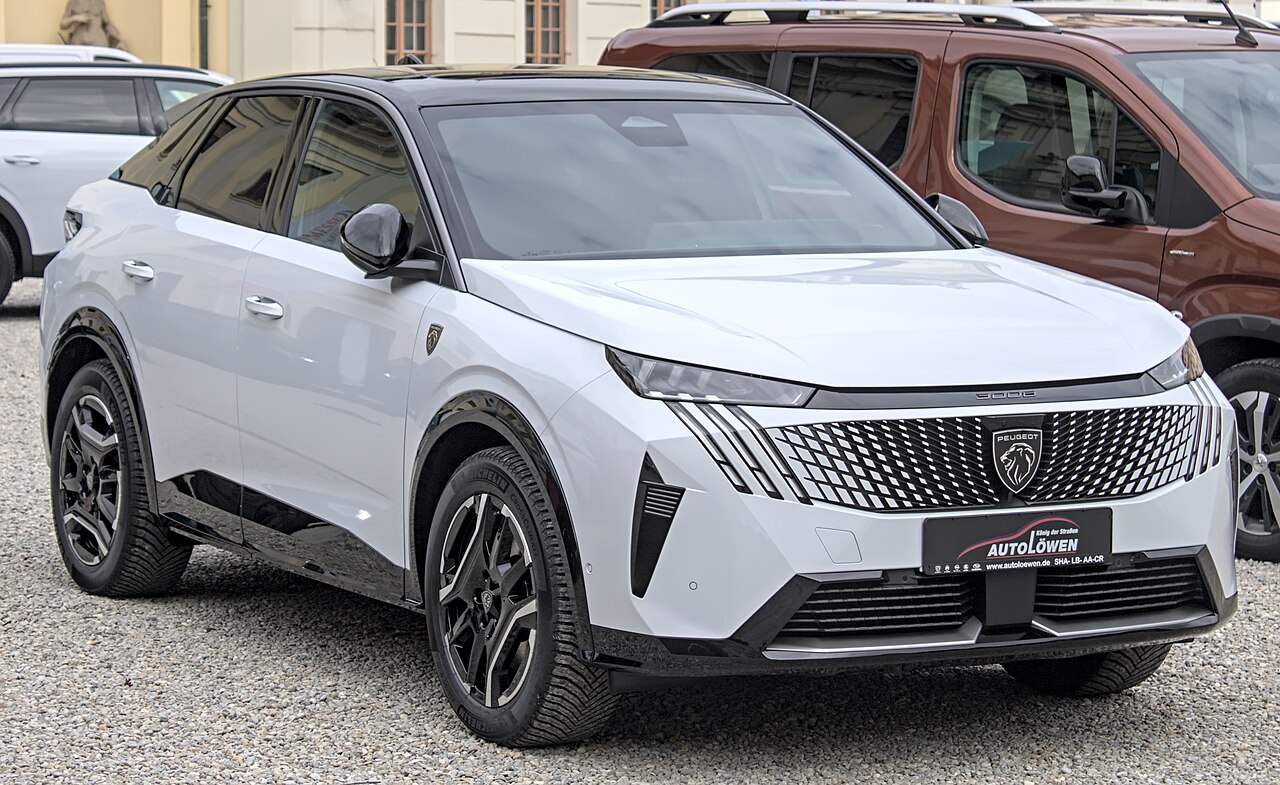 Foto con licenza · Crediti
MarcaPeugeot
Nuove immatricolazioni (UE)2008–2026
Generazioni e specifiche tecniche
Peugeot 3008 – 3ª generazione2024–oggi
| Caratteristica | Valore |
|---|---|
| Codice modello | P64 |
| Produzione | 2024–oggi |
| Carrozzerie | 5 porte SUV |
| Schema | Motore anteriore, trazione anteriore Front-motor, front-wheel drive Dual-motor, trazione integrale |
| Piattaforma | STLA Medium |
| Motori | Benzina 1,2 L EB2LTEDH2 turbo I3 1,6 L EP6FADTXD turbo I4 |
| Motore elettrico | 1 or 2 Permanent magnet AC synchronous motor |
| Cambi | 6 marce DCT 7 marce DCT 1 marce direct-drive fixed gear ratio (e-3008) |
| Trasmissione | Mild hybrid (MHEV) Ibrido plug-in (PHEV) |
| Batteria | Lithium-ion NMC 0,43 kWh (Ibrido) 17,9 kWh (Plug-in Ibrido) 73 - 96,9 kWh (e-3008) |
| Autonomia elettrica | 87 km (PHEV) |
| Passo | 2.739 mm |
| Lunghezza | 4.540 mm |
| Larghezza | 1.890 mm |
| Altezza | 1.640 mm |
| Assemblaggio | Francia: Sochaux (PSA Sochaux Plant) |
Peugeot 3008 – 2ª generazione2016–oggi
| Caratteristica | Valore |
|---|---|
| Codice modello | P84 |
| Produzione | ottobre 2016 – 2024 2016–oggi (Cina, Malesia) |
| Piattaforma | PSA EMP2 platform |
| Motori | Benzina 1,2 L EB2 turbo I3 1,6 L EP6 turbo I4 MHEV 1,2 L EB2ADTS turbo I3 PHEV 1,6 L EP6 I4 Diesel 1,5 L DV5 BlueHDi I4 1,6 L DV6F BlueHDi I4 2,0 L DW10 BlueHDi I4 |
| Motore elettrico | 1 or 2 Permanent magnet AC synchronous motor (integrated with the e-EAT8 gearbox) |
| Cambi | 5 marce manuale 6 marce manuale 6 marce e-DCS6 Dual Clutch Transmission 6 marce Aisin EAT-6 automatico 8 marce Aisin EAT-8 automatico |
| Batteria | 13,2 kWh Li-ion |
| Passo | 2.675 mm 2.730 mm (Cina, Malesia and Vietnam production) |
| Lunghezza | 4.447 mm 4.510 mm (Cina, Malesia and Vietnam production) |
| Larghezza | 1.841 mm (2.098 mm including wing mirrors) |
| Altezza | 1.615 mm – 1.623 mm |
| Assemblaggio | Francia: Sochaux (PSA Sochaux Plant) Cina: Chengdu (DPCA) Ghana: Tema (Silver Star Auto) Kenya: Thika (Kenya Vehicle Assemblers (KVM)) Namibia: Walvis Bay (Peugeot Opel Assembly Namibia (POAN) Nigeria: Kaduna (Dangote Peugeot Automobiles Nigeria Limited (DPAN)) Malesia: Gurun (Gurun Plant)<br/ >Vietnam: Chu Lai (THACO) |
| Designer | Sébastien Criquet |
Peugeot 3008 – 1ª generazione2008–2019
| Caratteristica | Valore |
|---|---|
| Codice modello | T84 |
| Produzione | 2008–2016 2010–2019 (Cina) |
| Piattaforma | PSA PF2 platform |
| Motori | petrol 1,2 L EB2 turbo I3 1,6 L EP6 I4 1,6 L EP6 turbo I4 diesel 1,6 L DV6 I4 2,0 L DW10 HDi I4 diesel ibrido 2,0 L DW10 HDi I4 |
| Cambi | 5 marce manuale 6 marce manuale 6 marce automatico 6 marce automated manuale |
| Passo | 2.613 mm |
| Lunghezza | Global: 4.365 mm Cina: 4.430 mm |
| Larghezza | 1.837 mm |
| Altezza | 1.639 mm |
| Assemblaggio | Francia: Mulhouse (PSA Mulhouse Plant); Sochaux (PSA Sochaux Plant) Cina: Wuhan (DPCA) Malesia: Gurun (NAM) Kazakhstan: Kostanay (Saryarka AvtoProm) |
Dati di omologazione UE
| Anni | Alimentazione | Motore | Potenza | Massa | CO₂ | Autonomia elettrica |
|---|---|---|---|---|---|---|
| 2023–2025 | Ibrida benzina | 1199 cm³ | 100 kW (136 CV) | 1631–1648 kg | 121–125 g/km (WLTP) | – |
| 2023–2025 | Elettrica | – | 157 kW (213 CV) | 2183 kg | – | 515–527 km · 167–172 Wh/km |
| 2015–2024 | Benzina | 1199 cm³ | 96 kW (131 CV) | 1325–1395 kg | 143–164 g/km (WLTP) | – |
| 2020–2024 | Ibrida plug-in benzina | 1598 cm³ | 133 kW (181 CV) | 1835–1838 kg | 29–32 g/km (WLTP) | 61–65 km · 154–164 Wh/km |
| 2018–2024 | Diesel | 1499 cm³ | 96 kW (131 CV) | 1492–1505 kg | 135–147 g/km (WLTP) | – |
| 2020–2023 | Ibrida plug-in benzina | 1598 cm³ | 147 kW (200 CV) | 1908–1915 kg | 29–31 g/km (WLTP) | 62–67 km · 152–161 Wh/km |
| 2018–2021 | Benzina | 1598 cm³ | 133 kW (181 CV) | 1504–1505 kg | 157–175 g/km (WLTP) | – |
| 2018–2021 | Diesel | 1997 cm³ | 130 kW (177 CV) | 1555 kg | 162–171 g/km (WLTP) | – |
| 2015–2019 | Benzina | 1598 cm³ | 121 kW (165 CV) | 1375–1475 kg | 171 g/km (WLTP) | – |
| 2015–2018 | Diesel | 1560 cm³ | 88 kW (120 CV) | 1375–1545 kg | 104–114 g/km (NEDC) | – |
| 2011–2018 | Diesel | 1997 cm³ | 110 kW (150 CV) | 1500–1669 kg | 114–142 g/km (NEDC) | – |
| 2016–2018 | Diesel | 1997 cm³ | 133 kW (181 CV) | 1540 kg | 168–170 g/km (WLTP) | – |
| 2011–2015 | Benzina | 1598 cm³ | 88 kW (120 CV) | 1474–1539 kg | 155–159 g/km (NEDC) | – |
| 2011–2015 | Benzina | 1598 cm³ | 115 kW (156 CV) | 1534–1608 kg | 159–178 g/km (NEDC) | – |
| 2012–2015 | Diesel | 1560 cm³ | 84 kW (114 CV) | 1496–1620 kg | 110–125 g/km (NEDC) | – |
| 2011–2015 | Diesel | 1997 cm³ | 120 kW (163 CV) | 1614–1808 kg | 90–169 g/km (NEDC) | – |
| 2011–2013 | Diesel | 1560 cm³ | 82 kW (111 CV) | 1496–1620 kg | 122–135 g/km (NEDC) | – |
Gli anni sono anni di immatricolazione. Ogni intervallo va dal 10° al 90° percentile dei valori dichiarati per le nuove immatricolazioni; non è una media. La massa è la massa in ordine di marcia. Per le auto elettriche la potenza è la potenza netta di omologazione, che può essere inferiore alla potenza massima dichiarata.
Caratteristiche principali
| Caratteristica | Valore |
|---|---|
| Motorizzazioni (UE) | Benzina, Ibrida benzina, Ibrida plug-in benzina, Diesel |
| Cilindrata (UE) | 1.199–1.997 cm³ |
| Potenza (UE) | 82–133 kW (111–181 CV) |
| Massa in ordine di marcia (UE) | 1.325–1.838 kg |
| Passo (UE) | 2.613–2.675 mm |
Anni e mercati
| Caratteristica | Valore |
|---|---|
| Nuove immatricolazioni (UE) | 2008–2026 |